Create a Wedding Album You'll Love Forever
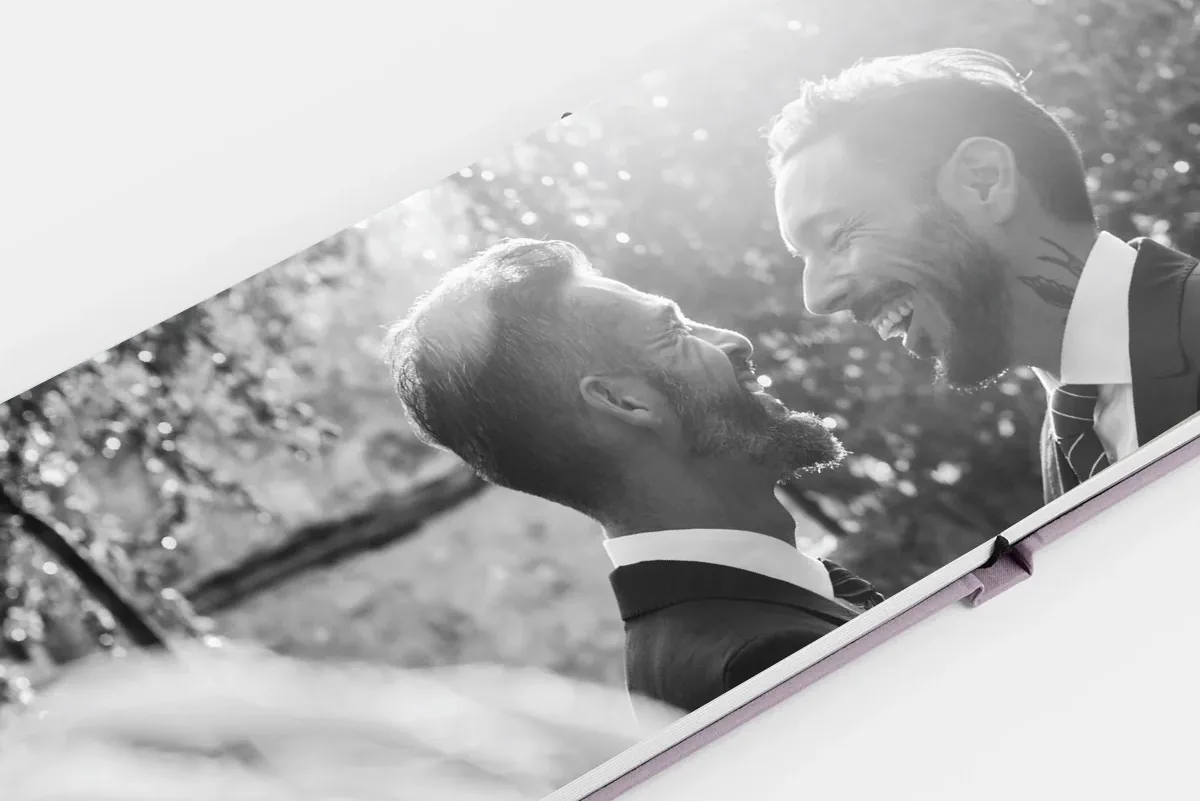
Your wedding gallery has hundreds of images. Your wedding album should have about eighty. The difference is curation — and curation is the whole game.
We design a lot of wedding albums. Here's what actually makes one that still means something in twenty years.
Quick answer
A wedding album that lasts has four elements: story structure (not chronology), 60–100 curated images, editing that ages well (true color, natural light, restrained contrast), and physical printing on archival-quality stock. Involve your photographer in the design — they know which images work together. Done in 3–6 months after the wedding, it becomes a 20-year object, not a one-time scroll.
Step 1. Think story structure, not sequence
The most common album mistake is treating it like a timeline. Hour-by-hour. Event-by-event. Results in albums that look like slideshow exports.
A better structure looks like a film:
- The opening. Getting-ready, anticipation, quiet details, a few portraits.
- The promise. Ceremony — vows, reactions, family.
- The celebration. Reception — toasts, first dance, laughter, the room.
- The legacy. Last dance, exit, afterglow, one final portrait.
This arc gives the album emotional shape. Chronological albums go flat by the middle.
Step 2. Curate to 60–100 images
Your photographer will deliver 400–800+ edited photos. Your album needs 80. The number is non-negotiable — more is scrapbook territory.
How to cut:
- One image per moment. Not three versions of the first kiss.
- No near-duplicates. Pick the best one and move on.
- Remove filler. If an image doesn't earn its spot, it's filler.
- Keep the specific over the generic. A candid you remember beats a perfect frame you don't.
If you can't narrow, ask your photographer. They see this fresh.
Step 3. Balance big moments with small details
A strong album mixes scale:
- Big scenes. The ceremony wide shot. The dance floor. The venue at night.
- Personal details. Rings, bouquet, handwritten vows, dress detail.
- Portraits. Couple, family, bridal party, guests.
- Candids. The in-between moments that actually happened.
Rhythm matters. Don't cluster all the details together or all the portraits together. Interleave. The album reads like breathing.
Step 4. Pick editing that ages gracefully
Trend editing dates fast. Heavy teal-and-orange, crushed blacks, pushed saturation, the month's trending filter — these will look like 2020s wedding photos the way 2006 wedding photos look unmistakably 2006.
Editing that ages well:
- True-to-life color. Skin tones that look like skin.
- Natural light. Honored, not fought.
- Restrained contrast. Balanced, not punchy.
- Classic black and white. Used sparingly, chosen for emotion.
Your photographer should offer an editing style that's consistent and classic. Ask to see weddings they shot five years ago. If they still look good — that's the editing you want.
Step 5. Print on archival-quality stock
Digital galleries depend on formats, platforms, and hard drives that will all change. A physical album depends on paper. Paper wins on a 20-year horizon.
What to look for:
- Archival-quality inks and paper. Pigment inks on acid-free stock.
- Lay-flat pages. Photos flow across the spread without a spine gap.
- Heavy cover stock. Hard cover, leather or linen, not soft-bound.
- Personalization. Names, date, or a meaningful phrase on the cover.
- Size. 10x10 or 12x12 are standard; larger for heirloom.
Pay for the good one. The cheap album will fade, warp, or fall apart. The quality album is a family object.
Step 6. Involve your photographer in the design
Your photographer has designed hundreds of albums. They know:
- Which images pair well across a spread
- Where to place a full-bleed image vs a clustered detail
- How to balance color, light, and emotion across the arc
- Which moment should open and close the book
Collaborative album design almost always beats solo-picking. We help our couples with this as part of our service — not as an upsell.
What the finished album should feel like
When your album is right, it:
- Flows — each spread feels intentional
- Includes people, not just decor
- Balances emotion and craft
- Looks like you, not like a template
- Still reads well in black-and-white (classic test)
- Carries weight — physical, emotional, visual
FAQ
Want help designing yours?
We design albums with our couples as part of our service. If you're ready to turn your gallery into something physical and permanent, start a conversation.
Planning your wedding?
Get a personalized quote from our team