Christmas Wedding: A Guide to Planning Your Festive Celebration
December weddings are a trade. You get venue discounts most of the year doesn't offer, a reception room that already looks dressed without you lifting a finger, and a romance nobody else is competing for. You also get a 4:30pm sunset, guests with overfull calendars, and a narrow window where everything can go sideways because of weather or a flight.
Couples who plan around the tradeoffs end up with weddings that feel genuinely like the season. Couples who don't end up with a wedding where the Christmas tree in the lobby is competing with their centerpieces.
Below is the real planning picture — what works, what to watch out for, and the decisions to make early.
Quick answer
The two biggest decisions for a Christmas wedding are timing and commitment. Time the ceremony so it starts at least 2.5 hours before sunset (usually 2pm or earlier in late December), and commit fully to the season — evergreen, candlelight, deep red or forest green, velvet — or skip the seasonal references entirely. Save-the-dates should go out 10 to 12 months in advance. Budget extra for guest-experience details (coat check, warm drinks, hotel blocks) and have a weather plan with specific thresholds, not a vague "plan B."
Step 1: Time the ceremony around sunset, not your preference
This is the single biggest mistake December couples make. A 4:30pm ceremony in mid-December in most of the US means the ceremony is in total darkness by the recessional. If you want natural-light ceremony photos — the kind you see in almost every wedding gallery you've saved — the ceremony has to start by 2:00 pm at the latest, and earlier if the venue is indoor with limited window light.
Look up the sunset time for your venue's zip code on timeanddate.com for the exact wedding date. Work backward:
- Sunset minus 30 minutes — golden hour ends, ceremony photos go dim
- Sunset minus 2 hours — first-look and couple-portrait window
- Sunset minus 2.5 hours — latest reasonable ceremony start
- Sunset minus 4 hours — ideal ceremony start for full daylight coverage
If you genuinely want an evening ceremony, commit to the candlelit indoor format — fully lit with pillar candles, sconces, tapers at head-height, dimmer fill lighting than a summer wedding. Your photos will lean warmer, softer, and flash-assisted. Beautiful, but different.
Step 2: Pick a decor lane
The best Christmas weddings we shoot fall into two camps:
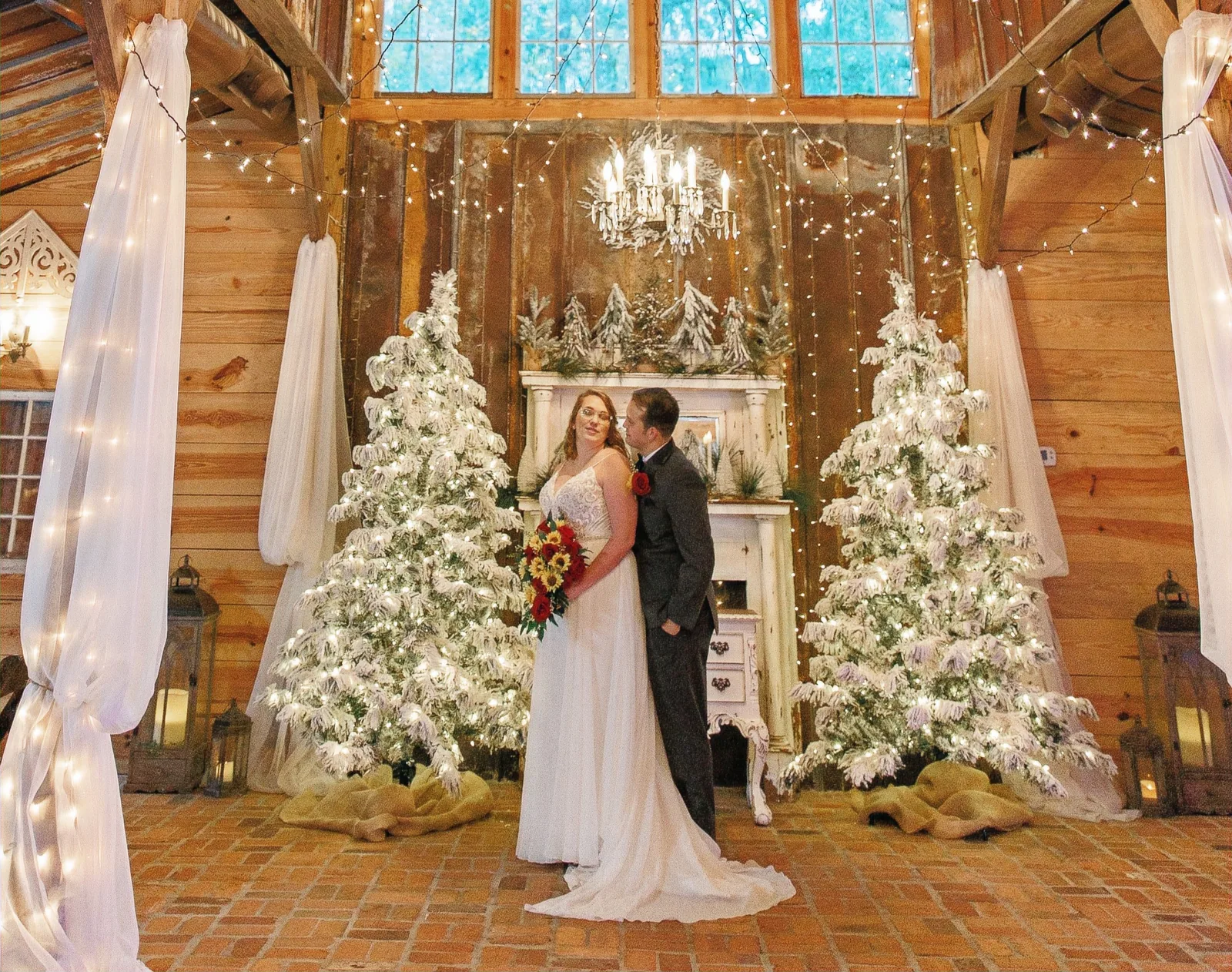
Lane one: full commitment. Evergreen garlands on every table, pillar candles in scale, deep red or forest green linens, wreaths on the ceremony chairs, a tree in the reception room that's actually part of the design. The room feels like a wedding that happens to be at Christmas — not a wedding with Christmas props bolted on.
Lane two: December, but not Christmas. White and ivory florals, neutral linens, clean modern tablescape, zero seasonal signaling. The fact that it's December shows up in the guest coats, not the decor.
The middle ground — a few sprigs of holly, one red ribbon, a single ornament per place setting — reads unfinished. Commit or skip.
Step 3: Handle the guest experience
December guests arrive cold, stressed about holiday logistics, and often already mid-travel. Small things move the experience up a lot:
- Coat check at the ceremony. Mandatory. Nobody wants to hold a parka through vows.
- Warm drink on arrival. Mulled wine, hot cider, spiked hot chocolate. Served as guests arrive, not during cocktail hour.
- Hand warmers for outdoor portraits. A box of the $1 chemical warmers by the exit. Your wedding party will thank you during group photos.
- Hotel room block near the venue. Not a 30-minute drive away. Icy roads and late-night Ubers make this more important in December.
- Late-night transport home. Many couples book a shuttle or at minimum pre-arrange a rideshare code. Guests drinking at a wedding in December driving on icy roads is the scenario you're avoiding.
These details are not nice-to-haves in December — they're the difference between a great night and a complaint-filled group text.
Step 4: Build the weather plan with real specificity
"We'll move indoors if it rains" is not a plan. A real plan answers:
- What weather triggers the move? Wind over 20mph? Snow accumulation over one inch? Wet chairs? Write the threshold.
- Who makes the call? The planner. Not you, not your parents, not the venue. Give one person the authority.
- When is the decision made? Usually morning-of at a set time (9am or 10am). Not 30 minutes before the ceremony.
- Where do guests wait if the move happens? The coat-check area is not a room. Map the actual space.
- What changes for vendors? The florist needs to know where the ceremony arch relocates. The photographer needs to know the indoor light situation.
Venues have usually seen every weather scenario. Ask specifically: "What was your worst-weather wedding and what did you do?" The answer tells you whether they're ready to handle yours.
Step 5: Protect the date against everyone else's December
You're competing with Hanukkah, work parties, family travel, school breaks, and every couple who thought "wouldn't Christmas week be magical?" first.
- Send save-the-dates 10 to 12 months out. June/July at the latest for a December wedding.
- Pick a date that isn't Dec 24–26 or Dec 31. These carry the highest family-conflict rate. Dec 14, Dec 21, and Dec 28 have historically drawn better attendance for our couples.
- Avoid midweek unless your guest list can travel easily. Midweek December is cheap at venues — because guests can't come.
- Consider a morning-ceremony-plus-lunch format. It sounds unusual but works: 11am ceremony, noon cocktail hour, 1pm seated lunch, 4pm send-off. Guests get home before dark, travel logistics simplify, and you still get the venue in holiday dress.
What makes a Christmas wedding photograph well
From our side of the camera, the weddings that shoot best in December share a few things:
- Warm indoor light. Incandescent string lights, pillar candles, warm-temperature sconces. Cool white LED strings will photograph harsh and bluish; swap them for warm whites wherever you can.
- A light color anchor. Even inside a deep-green-and-red palette, brides photograph best with something light in frame — a white bouquet, a cream coat, a silver or gold accent. Pure saturation is hard to expose.
- Indoor getting-ready spaces with window light. Hotel rooms near a large window beat windowless suites. Budget for a nicer getting-ready room if your venue's is dim.
- Planned outdoor portraits in the hour before sunset. If weather cooperates, even 10 minutes outside at 3pm will get you the frames people print. Bring the coats.
Frequently asked questions
Planning a December wedding?
If you're in the window where you're picking dates and vendors, start a conversation — we've shot December weddings from snowy Vermont to candlelit NYC brownstones to Florida beaches in sweaters, and we're happy to walk through timeline and light before you book anyone.
Planning your wedding?
Get a personalized quote from our team