Mixing Color & B&W Wedding Photos for Timeless Albums
Every good wedding album uses both color and black-and-white. The question isn't whether to mix them — it's how. When you use which treatment, and in what rhythm, is what separates a finished album from a finished gallery export.
Here's how we think about it when we design albums with our couples.
Quick answer
Use color for atmosphere, detail, and the visual richness of the day — florals, décor, golden-hour portraits, the dance floor. Use black-and-white for emotion, intimacy, and high-contrast moments — first looks, tears, candid family reactions, low-light exchanges. Most albums land around 70–80% color and 20–30% black-and-white, but let the photos dictate — not the ratio.
Step 1. Let each moment dictate the treatment
The best-designed albums don't pick a black-and-white quota. They let the emotional weight of each moment choose. Ask:
- Does color add to this image? If yes, keep it color.
- Does color distract from the emotion? If yes, convert to black-and-white.
A father-of-the-bride tear during the first look is usually stronger in black-and-white — the color of his tie isn't the point. A bouquet of rare peonies is usually stronger in color — the point is the color.
Step 2. When color wins
Color photography carries the visual experience of the day. Use it for:
- Ceremony details. Flowers, bridesmaid dresses, arch, linens.
- Reception décor. Tablescapes, signage, lighting, color palette.
- Sunset portraits. Warm golden tones are the whole point.
- Dance floor. DJ lights, colored uplighting, the party energy.
- Fashion shots. Dress, suit, accessories, the full visual styling.
- Venue wide shots. The establishing frames that show where you were.
If the atmosphere of the moment is visually rich, color photography respects that.
Step 3. When black and white wins
Black-and-white strips the image down to its emotional core. It works especially well for:
- The first look. Facial expressions over color of tie or dress.
- Vow reactions. Tears, laughter, the micro-expressions that land harder in mono.
- Parent dances. Generational connection, texture, contrast.
- Candid family moments. Hugs, tears, quiet conversations.
- Low-light situations. When color's going to be muddy anyway.
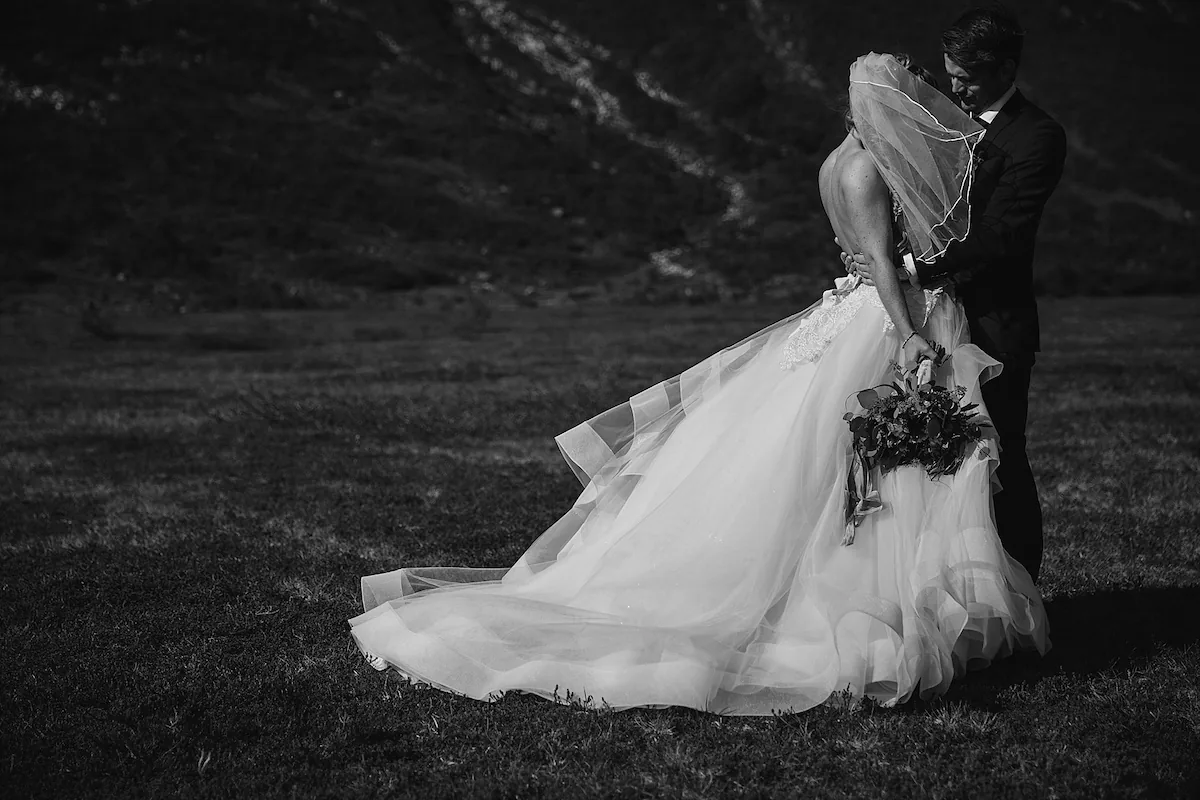
- High-contrast portraits. Strong shadow, strong light, architectural.
The rule of thumb: if color would be noise, go black-and-white.
Step 4. Group for visual flow
This is the technique most couples miss. Scattered single black-and-white photos across a color album feel inconsistent. Grouped black-and-white photos feel deliberate.
A good album rhythm:
- Opening spread (color). Getting ready, details, anticipation.
- Transition to B&W. Emotional first look and vow sequence.
- Back to color. Ceremony wide, family, venue.
- B&W again. Heartfelt speeches, parent dances, quiet reception moments.
- Color close. Dance floor, last song, exit.
Group the treatments so each one has its moment. Don't scatter them at random.
Step 5. Use black and white as anchor spreads
A single black-and-white image on a full-page spread, surrounded by color images on adjacent spreads, becomes a visual anchor. It stops the eye and forces a pause. These are your emotional peaks.
We usually recommend 2–4 full-page black-and-white spreads in a typical wedding album — no more. Use them for the moments you want readers to feel most deeply.
Edit decisions we make with our couples
Most of our edited galleries include both versions of key frames. When we design albums, we review side-by-side and choose:
- First look: which version carries more emotion?
- Ceremony kiss: does the color of the arch matter?
- Father-of-the-bride speech: color or mono?
- Parent dance: which version feels more generational?
- Portrait: which version reads better as a print?
The couple always has the final call. Our job is to offer the choice, not to dictate it.
FAQ
Build your album with a team that thinks this way
Start a conversation and tell us about your wedding. We design albums with our couples — color, black-and-white, and the rhythm between them.
Planning your wedding?
Get a personalized quote from our team