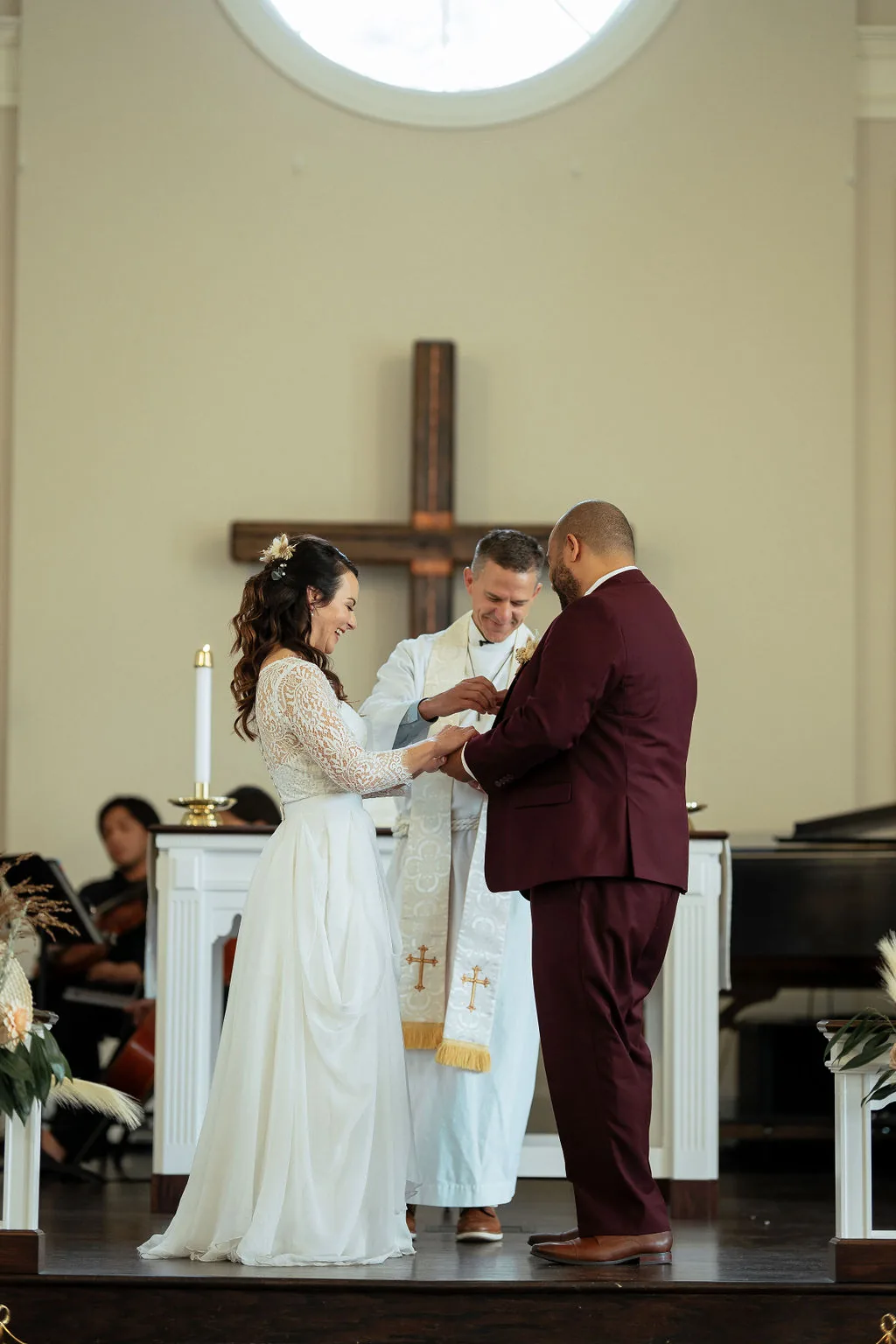
Can I photograph inside a military base chapel?
Usually yes, but every base has different rules. Some require advance approval, restrict flash photography, or limit where you can stand during the ceremony.
Most military chapels allow photography during weddings, but rules vary significantly by installation and branch. Some bases require the photographer to submit a request 30-60 days in advance through the chapel coordinator. Others restrict photography during the prayer or communion portions of the ceremony. A few chapels prohibit flash entirely, which means you need fast lenses (f/1.4-2.0) and high ISO capability (3200-6400). Always contact the base chapel office at least 6 weeks before the wedding to get the specific rules in writing. Do not assume what worked at one base will work at another.
What is the proper protocol for the sword arch or saber arch?
The arch is formed by 6-8 uniformed service members who raise their swords or sabers as the couple exits. The couple stops under the arch and the last pair traditionally taps the bride and announces welcome to the military family.
The sword arch (Navy, Marine Corps, Coast Guard) or saber arch (Army, Air Force) is performed as the couple exits the ceremony. Six to eight service members in dress uniform form two lines facing each other. On command, they raise their swords or sabers to form an arch. The couple walks through slowly. At the end of the arch, the last two members lower their swords to block the couple briefly. One of them taps the bride on the backside with the flat of the blade and says something like "Welcome to the Army" or the appropriate branch. As a photographer, you need to be positioned at the far end of the arch, shooting back through it, to capture the couple emerging. Use a 70-200mm at f/2.8 from about 40 feet away for the best compression of the arch lines.
Do military weddings cost more to photograph?
The photography itself should cost the same. However, base access requirements, advance approval processes, and uniform-specific detail shots add logistical time that some photographers account for.
The photography service itself is identical in scope to a civilian wedding. Many photographers offer military discounts of 10-15%, which is a common industry practice. However, military weddings do require extra planning time: coordinating base access for the photography team, understanding uniform regulations to avoid embarrassing errors, communicating with the chapel coordinator, and potentially dealing with security restrictions on certain types of photography. Some photographers fold this extra planning into their standard price; others may charge a small planning fee. Ask upfront.
When should the service member wear their dress uniform versus a civilian suit?
Dress uniform is traditional for the ceremony. The service member can change into civilian attire for the reception, or stay in uniform for the entire event. It is entirely personal preference.
There are no mandatory regulations requiring dress uniform at a wedding. It is personal choice. However, if a sword or saber arch is planned, the person being honored must be in uniform for it to be proper military protocol. Most service members wear dress uniform for the ceremony and portraits, then change for the reception since uniforms can be uncomfortable for dancing. Some stay in uniform all night. From a photography standpoint, the dress uniform photographs beautifully and provides a stunning visual contrast, especially with a bride in white. The medals, ribbons, and insignia also make excellent detail shots.
How do you handle rank protocol in military wedding group photos?
The highest-ranking officer or senior NCO is traditionally positioned closest to the couple. In mixed-rank groups, arrange by rank from center outward.
Military rank protocol in photos is not legally required at a wedding, but following it shows respect and avoids awkwardness among military guests. The general principle is that the highest-ranking individual stands closest to the couple (typically to the couple\'s right). In a lineup of groomsmen who are all military, arrange by rank from center outward. For group photos including commanding officers, they traditionally stand in the center or to the right of the couple. If you are unsure about ranks, ask the service member privately before the formal session. They will appreciate that you cared enough to get it right.
What if deployment changes the wedding date at the last minute?
Build a flexible postponement clause into your photography contract from the start. Most experienced military wedding photographers include this as standard.
Deployment orders can come with very little notice, and a wedding date can shift by weeks or months overnight. Before signing any photography contract, make sure there is a military deployment clause that allows date changes without penalty or with minimal rebooking fees. Good photographers who serve the military community already include this language. If they do not, request it in writing. Some photographers also offer a "deployment mini-session" option: a quick, affordable portrait session during leave if the full wedding gets postponed indefinitely. This way the couple has at least some professional photos together in uniform.