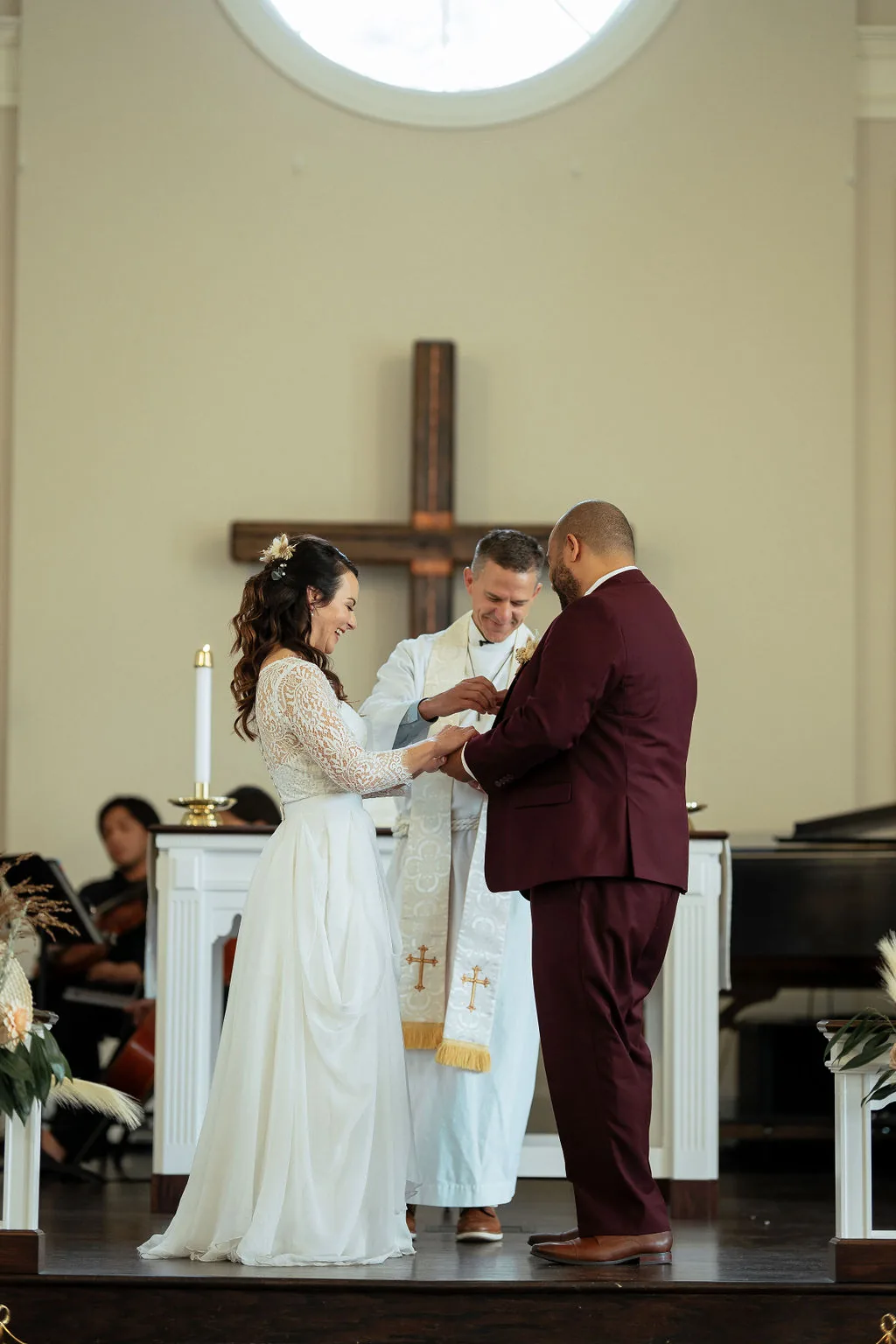
How do we include both traditions in the ceremony without making it feel like two separate weddings?
Weave traditions into one unified timeline rather than listing them sequentially. Work with both officiants together to create transitions that feel intentional. Mix symbolic moments (two people reading a unity ritual) rather than Christian part, then Jewish.
The best interfaith ceremonies flow like one story with two voices, not two back-to-back ceremonies. Instead of a Christian vow exchange then Jewish ring ceremony, try a joint opening blessing from both faiths, then vows from both partners, then both ring ceremonies together. Work with both your rabbi and pastor/priest weeks ahead to write the ceremony together. Ask them to contribute blessings and rituals they think matter most, then architect those into a coherent arc. Some couples do a unity ritual that blends traditions (lighting a candle together, handfasting). Others open with blessings from both faiths, do vows, then close with both blessings. The key is thoughtful design.
What if our families have very different expectations about the ceremony?
Have the hard conversation early with both families about what matters most to each group. Listen without defending, then create a plan that honors what's truly important, not everything everyone wants This matters significantly for your wedding overall..
Interfaith ceremonies often surface family tensions about belonging and respect. A Jewish family might emphasize the Huppah (canopy) as non-negotiable; a Christian family might feel strongly about Christian vows or a pastor's blessing. Talk with each side separately first, asking what feels religiously important versus culturally traditional. Often you'll find overlap, both want a blessing, a commitment moment, family involvement. Then sit with both families together (or have your officiant facilitate) and explain your vision. Most families soften when they see genuine respect for both traditions and a ceremony that includes meaningful moments from each. Pick your two or three most important moments from each tradition and build around those.
How long should an interfaith ceremony realistically be?
Plan for 35–50 minutes typically, as interfaith ceremonies naturally run longer when you're including meaningful elements from both traditions. Build that into your timeline, start ceremony 30 minutes earlier than normal This matters significantly for your wedding overall..
Interfaith ceremonies naturally run long because you're not cutting traditions, you're combining them. A Christian ceremony might be 25–30 minutes; a Jewish ceremony 20–30 minutes. Together, you're easily at 35–50 minutes unless you're ruthlessly paring down. This matters for your day's timeline. If you have a 4 p.m. ceremony start and it runs 45 minutes, you're at 4:45 p.m., putting cocktail hour pressure on. Build in 40–50 minute planning, not 25. Work with both your officiant and your photographer to choreograph this thoughtfully. Longer ceremonies need excellent pacing, avoid dead moments where nothing's happening. Some of the most beautiful interfaith ceremonies we've shot run 40+ minutes because every moment feels alive and intentional. That's worth the time. A rushed ceremony compressed to 25 minutes to save time always feels like something's missing.
Should we have two separate venues, one for each tradition's ceremony?
Rarely necessary and usually complicates logistics significantly in practice. Most couples do one ceremony with both traditions woven together, then celebrate at a reception reflecting both families' cultures as you plan your wedding overall. .
Some couples consider separate ceremonies (a church service for Christian family, then a Jewish ceremony for their Jewish side), but this almost always creates problems: guests feel divided, both ceremonies feel rushed to save time, and you lose a unified moment where everyone celebrates together. The couples we've photographed who chose one blended ceremony reported it was way more meaningful than trying to satisfy two audiences separately. If religious requirements are strict (some churches require Christian-only communion, some synagogues have specific rules), negotiate with your officiant about what you can adapt. Many will bend rules for interfaith ceremonies. If your venue has constraints (church ceremony only, then reception elsewhere), that's logistical, not spiritual. But don't create two separate events to avoid the conversations or planning. Work with your officiant and families to design one ceremony that includes both traditions thoughtfully. Your guests will feel the intentionality.
What readings and blessings work well in interfaith ceremonies?
Choose readings that speak to your shared values (love, commitment, family) rather than exclusively Christian or Jewish texts. Many couples include one reading from each tradition plus a secular reading that bridges both This is important..
The best interfaith readings are ones that don't require doctrinal alignment, think I Corinthians 13 (love), Ecclesiastes (community), secular poetry about commitment. Pair one reading from each tradition (a Jewish blessing and a Christian reading, for example) with a secular poem or family letter that speaks to both your visions. We've seen beautiful ceremonies where a grandparent reads a blessing in Hebrew, another family member reads a Christian passage, and a friend reads a poem about building a life together. The transitions between them matter, have your officiant explain briefly why you chose each. Skip readings if you're already hitting 40+ minutes. And vet readers, enthusiastic Aunt Sarah reading for the first time is a risk. A smooth delivery matters more than the reading itself.
How do we navigate photography and religious restrictions around camera use during ceremony?
Discuss camera restrictions with your officiant weeks ahead. Some traditions prohibit photography during specific rituals (like Jewish Ketubah signing, some Christian ceremonies). Plan those moments with your photographer so they understand restrictions This matters significantly for your wedding overall..
Different religious traditions have different rules about photography. Some synagogues prohibit photography during the ceremony itself; others allow it freely. Some churches want no flash during vows or communion. Orthodox Jewish ceremonies have specific photography restrictions. Talk with both your officiant and photographer well before the wedding day. A good photographer will work within those constraints and still deliver beautiful images, they'll position themselves where they're allowed, use natural light strategically, and capture reactions and surrounding moments rather than forcing photography where it's not welcome. If a ritual is off-limits for photos, brief your family and guests so they know it's intentional, not a surprise. Some couples ask a family member or friend with a phone camera to capture that moment candid-style if photos are restricted for professionals. The goal is respect for tradition and good documentation, your photographer should be an ally in both.