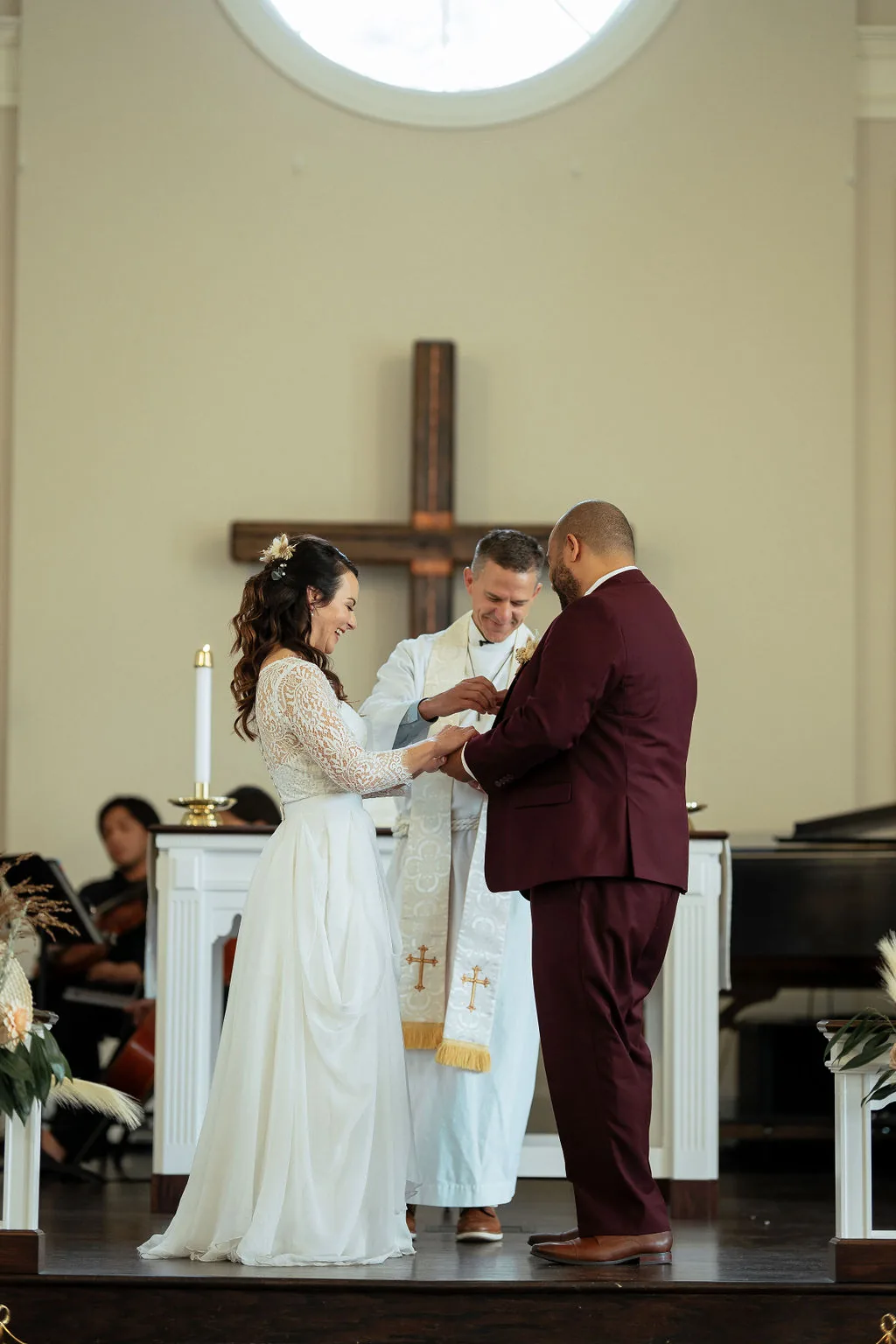
How do we honor children from previous relationships in the ceremony?
Include children in the ceremony itself: have them walk down the aisle, stand beside you at the altar, or participate in a unity ritual. This makes them feel like they're part of the commitment you're making, not sidelined observers.
Including children ceremonially sends a powerful message: this marriage isn't just about two people, it's about building a new family unit where they belong. Some couples have kids light candles, hold the rings, or stand as witnesses. Others do a unity ritual where you all plant a tree together, pour sand together, or light a candle together. The ritual doesn't have to be religious or complicated; it's just a gesture that says, "We're doing this together as a family." Talk to the kids beforehand so they know what to expect and feel confident in their role. This approach makes the ceremony genuinely about creating a new family, not just celebrating a couple.
How do we handle seating and family dynamics on the wedding day?
Ask a trusted family member or friend to be the day-of coordinator for seating. Brief them on any sensitive dynamics (who shouldn't sit near each other, ex-partners' boundaries) so they can handle it calmly without creating drama.
Blended families sometimes have genuine friction: ex-partners, stepsiblings who are new to each other, or relatives who haven't fully accepted the new family structure. Don't surprise people with awkward seating arrangements. Talk to key relatives beforehand about where they'll sit and why. If an ex-partner is invited (sometimes necessary for kids' sake), seat them away from the couple's immediate family circle. Have a plan for kids' seating, do they sit with one biological parent or split between tables? Communicate this clearly and calmly before the wedding. Brief your ceremony coordinator or trusted friend on the full family map so they can handle unexpected situations without you having to manage family drama on your wedding day.
Should we take family photos with ex-partners present?
No. Family photos should include the new family unit you're creating together. If kids have two parents present, photograph them separately with each parent, not awkwardly together. This matters for your wedding day success.
Your wedding photos are about your new marriage and your merged family moving forward into the future. Including an ex-partner in family portraits complicates the visual narrative and makes future viewing awkward or uncomfortable. Instead, do separate photos: one of you with your kids, one with your partner and their kids, one of the entire blended family together. If both kids' biological parents are at the wedding, take photos with each separately so everyone's comfortable. This respects everyone's roles and boundaries without forcing uncomfortable situations into your wedding album that you'll see for decades. Your photographer should be briefed on family structure so they can suggest the clearest, least awkward groupings.
How do we talk to kids about the new family structure before the wedding?
Be honest and age-appropriate. Explain that you're getting married to create a new family, that everyone's relationships matter, and that the wedding celebrates this. Kids do better when they understand.
Age matters here because different children need different explanations. Older kids might worry about loyalty to absent parents or what changes for them practically. Younger kids might just see a party. Have separate conversations with kids, their other biological parent (if possible), and your partner's kids. Normalize the fact that blended families are common now. Explain clearly that getting married doesn't erase their relationship with either biological parent. Answer their questions honestly and age-appropriately. If a kid doesn't want to participate in a ceremony role, don't force it. The more you normalize these conversations and communicate clearly, the less anxiety they feel, and the more they can actually enjoy the day.
What if kids are resistant to the marriage or the new family?
Acknowledge their feelings without letting resistance derail your day. Involve them in small, meaningful ways so they feel heard. Consider family counseling before the wedding to work through bigger issues.
Blended families have genuine friction sometimes, and that's normal. A kid might worry they're being replaced or feel caught between parents with different opinions. Don't pretend everything's perfect if it's not. Listen to their concerns, validate their feelings, and work with a family therapist if tensions are serious. On the wedding day itself, include them in ways that feel comfortable, they don't have to smile for the camera, but they should feel like they belong. Expect some kids to be standoffish in photos; that's real and valid. The goal isn't forcing happiness but building a foundation where everyone can eventually feel secure in this new family unit. That deep work takes time and patience beyond the wedding day.
How do we avoid hurt feelings when inviting family members?
Be thoughtful about who you invite from blended family branches. If you're inviting kids' grandparents from both sides, invite them from all sides equally. Communicate clearly about plus-ones to avoid confusion.
In blended families, family politics get complicated fast. If you invite your partner's children's grandparents, inviting your own kids' other biological parent might be a conversation worth having with your partner. Be explicit about plus-ones: do kids get to bring friends? Do adult children get a plus-one? What about the other biological parent, will they be invited? Communicate these boundaries in writing so no one's guessing or feeling excluded. Some family members might feel resentful or excluded; that's sometimes unavoidable, but clarity prevents unnecessary hurt. If certain relatives can't handle the blended family situation emotionally, it's okay to make boundaries. Your wedding is about your new family unit, not pleasing everyone's expectations.